

Art Basel Miami Beach 2025: The Week in Highlights, From Untitled to Design Miami
Miami Art Week doesn’t ease in. It hits at full speed—sharper light, louder streets, and an art calendar that feels like it’s sprinting just ahead of you.
For Meso Ventures, the week is equal parts scouting trip and cultural barometer. We come to look closely, track signals, and find the artists and objects that hold up after the first rush of attention fades.
What follows aren’t the loudest moments. They’re the ones that lingered.

Giuseppe Lo Schiavo presented at Untitled Miami 2025 Art Fair
The First Landing Ritual: Untitled Art Fair
Every year, our first stop is Untitled Art Fair — one of the strongest satellite fairs around Art Basel Miami Beach and, consistently, one of the best places to encounter emerging artists who already have real command of their practice.
The pace there is different. Conversations are still possible. Work can still be seen before it becomes crowd consensus.
This year, Untitled felt especially focused: presentations with clarity, booths with intention, and the kind of breathing room that lets you understand what an artist is actually doing.
Giuseppe Lo Schiavo: Architecture, Light, and the Surreal Window
Our most iconic discovery at Untitled was Giuseppe Lo Schiavo. The architectural background matters—you feel it immediately. His compositions understand structure and depth, and the way light behaves isn’t decorative; it’s built into the logic of the work.
His “windowscapes” carry a surreal pull, like openings into a reality that doesn’t exist but still feels plausible. The work plays with architecture, reflection, and illusion in a way that’s both cinematic and precise. It’s the kind of imagery that follows you out of the booth—and keeps replaying behind your eyes.
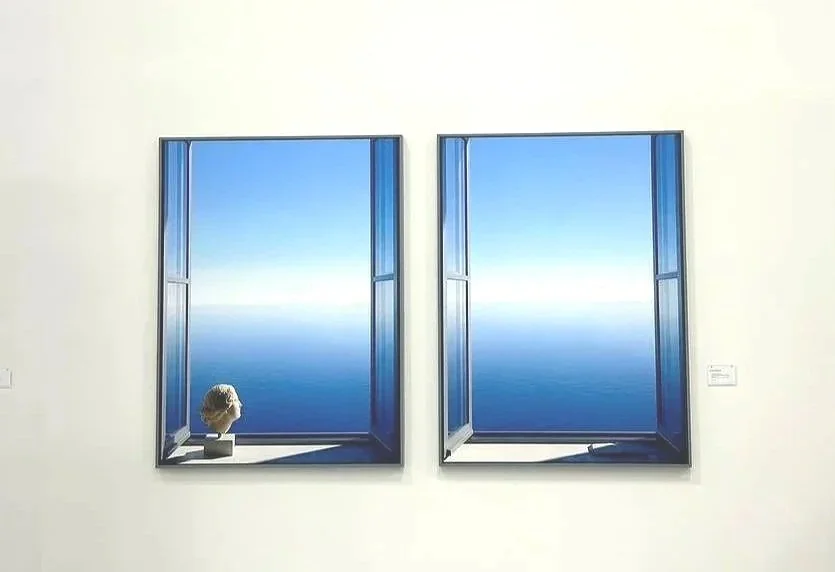
Giuseppe Lo Schiavo presented at Untitled Miami 2025 Art Fair new body of work
Yulia Iosilzon with MIRO Presents: When Ceramic Reads Like Painting
Another Untitled moment came through MIRO Presents, featuring London-based Yulia Iosilzon. Her work stops you because it tricks the brain in the best way.
At first glance it reads like painting. Then you realize it’s glazed stoneware, assembled like a connected puzzle. The surface is painterly-soft, but it’s built from material and structure—image and object collapsing into one.
The artwork we kept returning to was “Beyond Appearance (Mount Sinai), 2025”. In person, it had compositional confidence and the rare quality of rewarding time: the longer you stayed, the more it gave back.

Yulia Iosilzon “Beyond Appearance (Mount Sinai), 2025”
Rosenfeld gallery (London): Natalia Ocerin’s Hyperreal, Circus-Adjacent World
At Untitled’s Artist Spotlight, we spent time with Rosenfeld gallery from London, presenting Spanish artist Natalia Ocerin. The booth felt immersive and intense—surreal, “circus-adjacent,” and uninterested in pleasing everyone. It was committed to its own atmosphere.
Ocerin is known for hyperreal paintings that critique consumer culture, and the process is part of the story. She builds plasticine models first, then paints from them. This presentation included those plasticine maquettes—shown for the first time in this context—and that detail changed how the paintings read. You could see the construction behind the illusion.

Rosenfeld Gallery presenting Spanish artist Natalia Ocerin at Untitled Miami 2025 Art Fair
Faena Art Week: The Installation Everyone Orbited
After Untitled, we passed through Faena and found one of those Miami Art Week moments that feels instantly iconic.
Faena Art presented a large-scale installation—a rotating structure of bookshelves staged on water, with text and quotes woven into the experience. People slowed down around it, which is no small thing during Miami Art Week. It was photogenic, yes, but also genuinely magnetic in person: a visual anchor for the neighborhood.

Faena Art Miami 2025
Midweek Marker: Serpentine’s VIP Brunch at Casa Tua
On Wednesday, December 3, we attended the annual Serpentine Americas Trustee and Serpentine Council VIP brunch at Casa Tua—one of those fixtures that reliably gathers a familiar, art-world mix.
We saw Bettina Korek, CEO of Serpentine, and Hans Ulrich Obrist, Serpentine’s Artistic Director. The brunch was hosted by Serpentine Americas Trustee Ted Vassilev. It felt like a reset before the main fair opened: a gathering point before the city scattered into booths, openings, and dinners.

Serpentine’s VIP Brunch Miami Art Basel 2025 at Casa Tua
Inside Art Basel Miami Beach: Works We Kept Circling Back To
Opening day at Art Basel Miami Beach has its own pressure. The aisles fill fast. Conversations turn transactional. The best works become landmarks people navigate by.
Still, there were real highlights—works that held their ground even in the noise.
For collectors looking to navigate major art fairs with advisory support — identifying works with long-term value, accessing private previews, and managing acquisitions on the ground — MeSo Ventures offers dedicated art fair advisory as part of its broader collection building services. Get in touch to discuss how we can support your next fair visit.
Ariana Papademetropoulos at MASSIMODECARLO
At MASSIMODECARLO, we saw Ariana Papademetropoulos’ “Natural Histories” (2025) — a piece that felt like a portal. A seashell form, water flowing out, and a magical forest atmosphere that landed somewhere between playful and eerie. It had scale, imagination, and technical control: a strong “only in Miami” moment in the best way.

Ariana Papademetropoulos’ “Natural Histories” (2025)
Vadehra Gallery: Zaam Arif’s Existential Narrative
At Vadehra Gallery, Roshini Vadehra was present and showing work by Zaam Arif. His practice carries philosophical weight—absurdity, memory, identity—without turning into explanation. Figures sit inside narrative spaces that feel like scenes from a dream you almost remember. The paintings had presence, but also looseness. They didn’t over-assert themselves.

Zaam Arif, The Maker, 2025
Eva Helene Pade: Two Paintings That Cut Through
We noted Eva Helene Pade in two separate moments that both stayed with us: “Efter Midnat” (2025), presented by Galleri Nicolai Wallner, and “Sol” (2025), shown by Thaddaeus Ropac. Both works carried atmosphere without noise—quietly confident, able to hold a wall without begging for attention.
Flora Yukhnovich at Victoria Miro
We will always stop for Flora Yukhnovich, and this year was no exception. At Victoria Miro, “Leda and the Swan” (2025) delivered exactly what we look for in her practice: tension inside beauty, and movement that never settles.
The Work Everyone Talked About: Warhol’s Muhammad Ali
One of the most discussed pieces on the floor was Andy Warhol, “Muhammad Ali” (1977)—acrylic and silkscreen ink on canvas—shown by Lévy Gorvy Dayan. It had that rare fair quality where people talk about it even when they’re not in front of it. It becomes part of the week’s shared vocabulary.

Andy Warhol, “Muhammad Ali” (1977)
Evening Event: “The Eye of India” at the Shelborne
That Wednesday night, we attended a major event presented by Forbes, UBS, and The Asian American Foundation titled “The Eye of India.” It was hosted by Nina Magon, fashion designer Masaba Gupta, and poet Rupi Kaur, with a performance element that brought dance into the evening’s narrative.
The setting at the newly reimagined Shelborne Miami Beach worked beautifully. The tone was intimate but ambitious—Indian heritage framed through a modern global lens—and it felt like a debut with real intention. Art dialogue followed as well.

Rupi Kaur at “The Eye of India”
Design Miami 2025: Collectible Design With Personality
We carved out time for Design Miami, where the week shifts from spectacle to living with objects. The best presentations there don’t feel like products—they feel like characters.
One of the first pieces we saw was RAY and Gufram’s “Fiore di Cactus,” edited by Francesco Vezzoli—a theatrical reimagining of Gufram’s cactus icon from 1972 (by Guido Drocco and Franco Mello). It was playful, bold, and unmistakably Miami.
We also loved what Fendi presented with Fonderia Fendi by Costanza (Conie) Vallese, a presentation grounded in craft and atmosphere.
From Dubai, Roham Shamekh Studio showed a memorable piece that wasn’t trying to be universally “practical.” It was niche by design. Roham even invited us into a meditation moment, which made the presentation feel closer to a ritual than a showroom.
And at David Gill Gallery, we noted Saint Clair Cemin’s bronze candelabra, “Whale and Monkey” (2025)—witty, weighty, and balanced in that rare way collectible design can be: sculpture that still functions.
Art Fair Advisory: How MeSo Ventures Approaches Miami Art Week
For collectors, Miami Art Week can be overwhelming — dozens of fairs, hundreds of booths, and a social calendar that competes with the art itself. MeSo Ventures attends as advisors first: our priority is identifying artists and works with genuine long-term relevance, not just what is generating noise in the moment.
That means starting with Untitled before the crowds arrive, tracking artists we already follow across multiple fair contexts, and building a picture of which galleries are making serious curatorial decisions rather than commercial ones. For clients who want to acquire at fairs like Art Basel Miami Beach, having an advisor on the ground — who has seen the work in person, spoken to the gallerists, and can assess condition, pricing, and market positioning — makes a meaningful difference to both the quality and confidence of the acquisition.