

Colour as Memory: A Conversation with Parnika Mittal
By Eirini Meze | MeSo Mag
Parnika Mittal is not an artist who stays still. Born in 1993 and raised across cities — from the small town of Agra to the hills of a boarding school, from Mumbai to Delhi, and eventually to London's Central Saint Martins — her life has been shaped by movement, and her practice by everything that movement leaves behind. Ahead of her upcoming group exhibition The Mythologies of Colour at Soho House Mumbai, we sat down with the Delhi-based painter and printmaker to talk about memory, belonging, colour, and why she will never let go of vibrancy —no matter how difficult the subject.
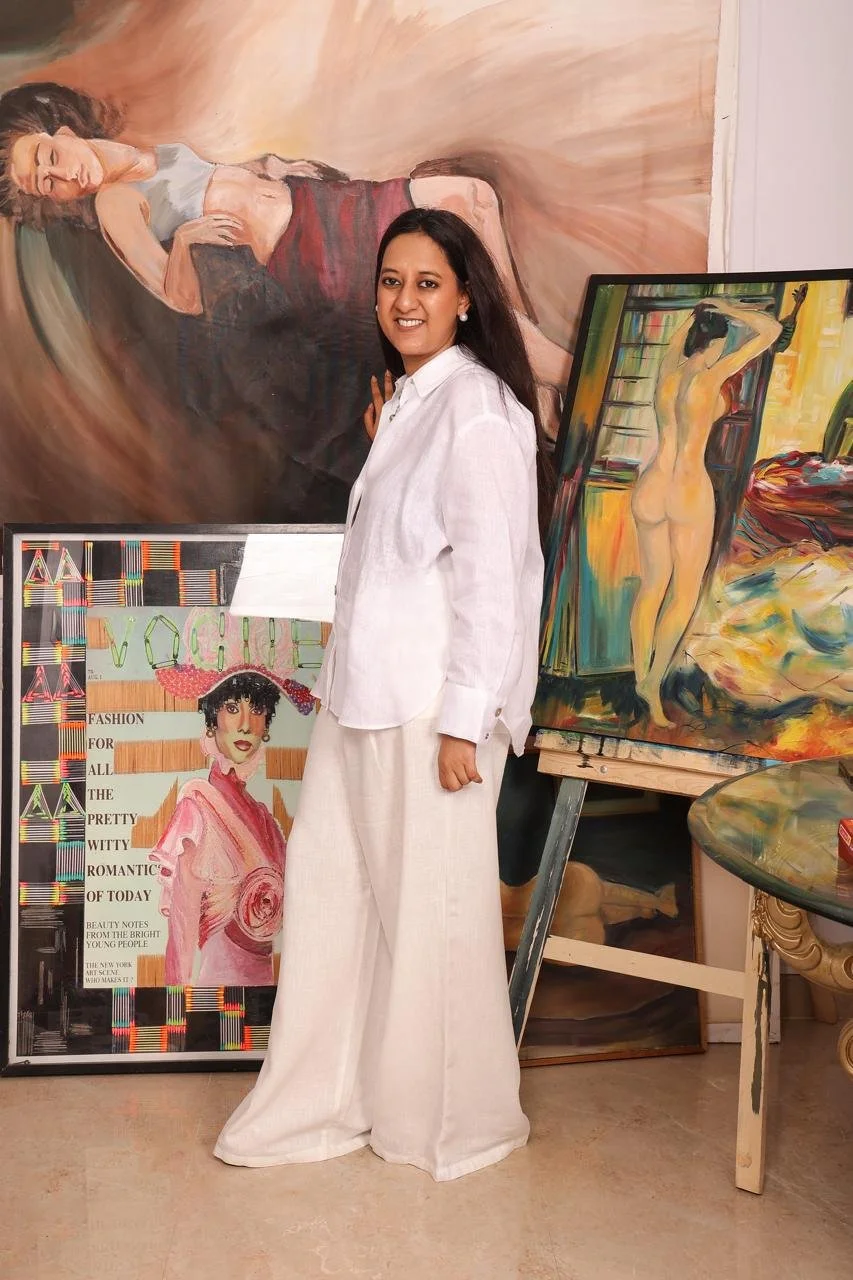
From Fashion to Fine Art: Finding the Right Medium
You studied fashion design in Mumbai before pivoting to fine art and then graphic design in Delhi. That's quite a journey — what drew you away from fashion?
I realised fairly quickly that fashion wasn't my cup of tea. I wanted to do something purely artistic, something where I had complete control over the final output. So I moved to Delhi and did a four-year degree in fine art, and during that time I became really attracted to printmaking— which my current practice still reflects.
To develop my own screens for printmaking, I needed to shoot my own photographs and handle my own image editing, which led me to study photography and graphic design at NIFT for a year. But I didn't pursue it entirely, because even then I felt I didn't have enough control over the final result. It wasn't until I got to Central Saint Martins that everything clicked into place — I had access to both painting and a dedicated printmaking studio simultaneously. That combination was what I'd been looking for.
The Process: Screen Print, Paint, Repeat
Can you walk us through how a work actually comes together? The process soundsquite layered.
It is a lot of back-and-forth. I begin by developing the image I want to print — the screen is created digitally, edited in Photoshop, and then I produce a full physical screen. From there I manually print onto canvas. I use masking tape and paper to block out the areas where I don't want ink to go, and there's a lot of building and adjusting in that stage.
Once the screen print is done and I'm happy with it, I paint on top. The chemical nature of thescreen print means the surface is never truly flat — there's always texture and relief, which means even the marks I paint over it remain visible underneath. That layering is very intentional. The print becomes a kind of structural memory beneath the paint.
So it's genuinely mixed media in the truest sense — not just a label.
Exactly. It's not one thing sitting on top of another. They interact. The mono quality of the print contrasts directly with the vibrancy of the painted colour, and that tension is central to what thework is about.
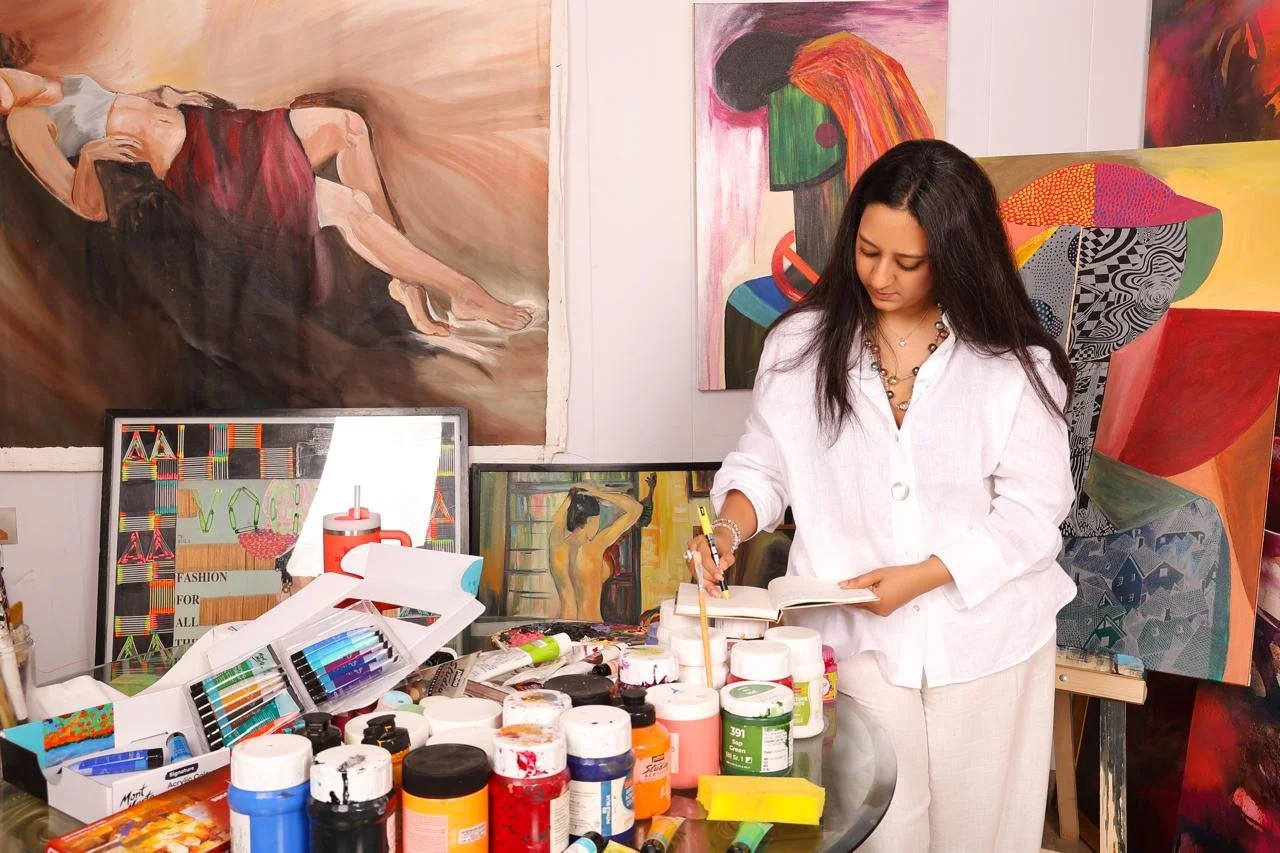
Parnika Mittal in her studio
The Series: Memories of Homes, Fragments of Self
The current body of work on show in Mumbai is centred around the experience of moving — different homes, different cities, different relationships. Where does that come from personally?
I've never really related to just one house. For me now, it's easy to pack my bags and relocate to another city or another country. But every time I've moved — whether it's a house, a city, or a country — something has left an impact. It could be the memory of a room, a relationship, a friendship, even a pet. And those memories appear in my work in a fragmented way, layered across the canvas.
You mentioned you moved around a lot even before London — not just with your parents, but alone?
Yes, I was moving by myself. My parents are from a small town near Agra where there were genuinely no opportunities for art — not a gallery, not a museum, not even really a decent art supply shop. My family comes from generations of business, nobody is an artist. So I went to boarding school in the hills at the age of ten, and from there it was Bombay, Delhi, London —always following where the art could take me.
And now you have your own studio in Delhi?
Yes. I live with a friend — partly for practical reasons, because I travel a lot and I have a cat —but I have my own space and my own studio. It feels like the most settled I've been, while still being completely open to moving again.
Colour as Resistance: The Palette That Never Changes
One of the most immediately striking things about your work is the colour — it's extraordinarily vivid. It almost reminds me of Holi. Is that a conscious cultural reference?
The colour palette definitely comes from my cultural background. Growing up in India, you are surrounded by colour — in textiles, in festivals, in everyday life. When I was working more heavily with printmaking, I did experiment with incorporating actual fabric into the prints. I could eventually let go of the fabric, but I could never let go of the colour.
For me, vibrancy brings joy. Every time I see strong colour it produces something positive, and I want that to be part of the experience of the work — even when the subject is difficult. Evenwhen I'm painting about a harsh memory, or something closer to a nightmare, the colour palette stays strong. The print carries the darkness in its monochromaticism; the paint insists on life.
That's a powerful tension — grief and joy held in the same frame.
I think I've come to terms with whatever life throws at me. I'm not going to sit and lament that I had to move again, or that something ended. Every experience teaches something, even if you don't appreciate it in the moment. Five years later you realise it added meaning. My colour palette reflects that — it's a firm belief in gratitude, in the end.
Delhi, Mumbai, and the Changing Art Scene in India
You've spent significant time in both Delhi and Mumbai. There's often a perception that Mumbai is more commercially focused on contemporary art — do you think that's fair?
Delhi also has a lot to offer in terms of contemporary art. There's been a real shift in awareness over the past few years — with more art fairs, museums, exhibitions, and institutions, people have started engaging with art in a different way. It used to be that emerging artists were largely overlooked, especially in comparison to established names. That's changed.
I remember coming back to Delhi during a break from Central Saint Martins — I was the only Indian on my course — and people would ask me why I was going to London to study art. "Isn't art just a hobby? You could practice at home." That attitude still exists, but it's fading. New galleries are opening, younger collectors are emerging, and there's more serious critical conversation happening.
And Mumbai specifically, for this show?
Bombay is a financial hub, and with more galleries and cultural institutions coming up there, it feels like the right moment. Soho House Mumbai is a very culturally active venue — they genuinely promote art and community. I'm excited to show there, and I did look at the other artists in the exhibition. It's quite something to see how one shared theme can generate so many completely different emotional perspectives. That's what's exciting about it.
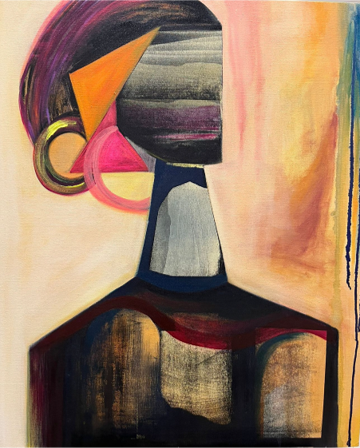
Parnika Mittal, Where I begin, 2025
The Mythologies of Colour: Showing at Soho House Mumbai
Tell us about the show itself — who are you exhibiting alongside?
There are four artists total — two British, one Indian, and myself. We're all very different in terms of medium and approach, but there are threads that run through the work: colour, emotion, the idea of identity and place. The show is titled The Mythologies of Colour, which feels right for what I'm bringing to it — the idea that colour itself carries history, memory, and meaning.
The works in the show — are they part of an ongoing series or a defined body of work?
It's one of those things where each work has led to the next, but they're also deeply interconnected and interwoven. That's actually reflected in the title of the series I'm showing: Woven. Going forward, as life gives me new experiences, the work will evolve accordingly. It's not fixed. But the threads — the colour, the memory, the movement — those remain.
The Mythologies of Colour opens at Soho House Mumbai in 2026. For enquiries about available works by Parnika Mittal, contact us.