

Between Generations: A Conversation with Tiyana Mitchell
By Eirini Meze | MeSo Mag
Tiyana Mitchell was born in Scottsdale, Arizona in 2001, but her paintings reach much further back — her grandfather's albums, a timeline spanning from the 1920’s to 1970's between the Middle East and Europe, places and faces at times anonymous. Now based in London and has just completed her MA in Painting at the Royal College of Art, Tiyana Mitchell is one of the most quietly compelling young painters working with archival material today. Her canvases are warm, sepia-toned, and deliberately timeless — populated by suited figures whose faces dissolve into paint, whose stories she is still piecing together. We spoke about family, photography, diplomacy, and the particular freedom of painting what you can't fully know.
Art in the Family: A Lineage of Looking
Eirini Meze: You've spoken about growing up surrounded by a real appreciation for the arts. Was there a sense from early on that this was the path for you?
Tiyana Mitchell: There's always been a trail of art and creativity in my family. My grandfather had a deep interest in photography, so the family albums are essentially built from his images — he was documenting life throughout his years. My mother was in ballet, my cousin is a fashion designer, and my grandfather was also a pianist — not professionally, but he genuinely loved it. Whenever we visited him, he was always at the piano, and you could hear it echoing through the house. We grew up with a very strong appreciation for the arts, and I feel like that's what's coming through in the work now.
Eirini Meze: And your great-grandfather is a significant figure in the work itself — can you tell us about him?
Tiyana Mitchell: My great-grandfather had a LL.D in law and spoke seven languages. He was the highest ranking Arab official in the British mandated government and served as District Commissioner of Jerusalem in 1944 before embarking on a distinguished political career in Jordan. He held the position of Minister of Foreign Affairs twice (1949 and 1950), and also served as Minister of Justice, Minister of Education, and Minister of Defence between 1950 and 1952. He was very much part of a pivotal moment in the history of the region. My grandfather passed away when I was very young, and the albums show the lives of both my great grandfather and grandfather. It is part of what makes the research feel so important to me - I'm trying to understand the lives of people so close to me that I barely knew, through the images my grandfather left behind.
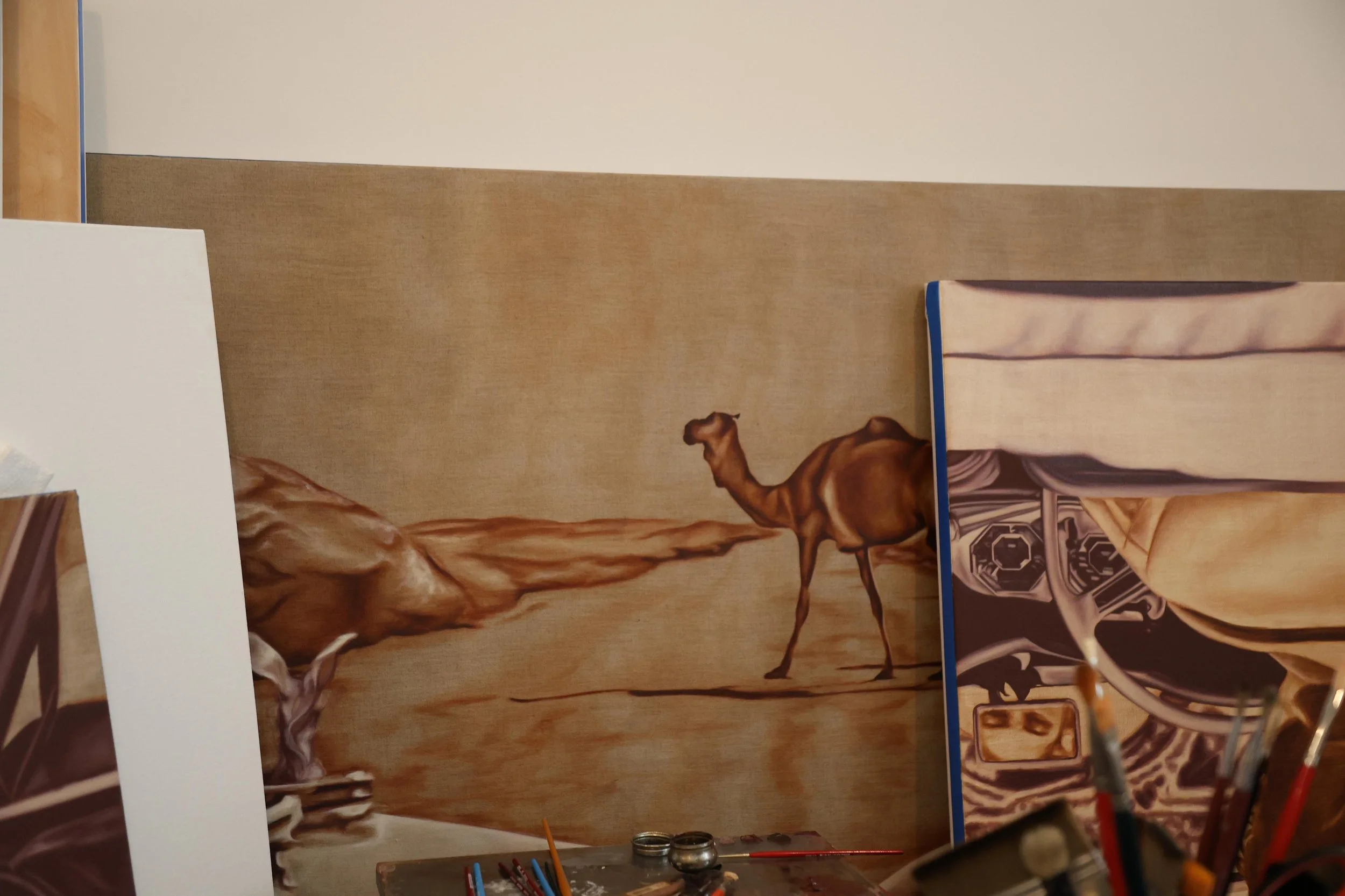
At Studio with Tiyana Mitchell, London 2026
Eirini Meze: How have you gone about learning more about him, given that he passed when you were so young?
Tiyana Mitchell: It's been a combination of family and archive. Through stories from my grandmother, his sisters, my mother and aunties, they have all given a peak into his life and allowed me to begin to understand the images. One of my aunties would also film moments of the family and seeing him play the piano is something quite special. But I've also done a lot of research online — I was fortunate to find an interview he had done in the 1990’s, where he is going through the albums, describing the individual images and placing some photographs back into the pages of the albums. Hearing him speak about the stories behind each photo — that was very moving.

Close up from Tiyana Mitchell, Roll 11 London 2025: 12, 2026
The Archive: Entry Point into a Family History
Eirini Meze: How did the photographic albums become the central focus of your practice?
Tiyana Mitchell: It started with a conversation I had with someone that led me to the photos for the first time — right before Covid hit, as it happened. So I had a lot of time during lockdown to research online before I could actually go and physically look at the albums properly. When I eventually did, I spent a significant period scanning every album to create digital copies. It's been a very special process — I’ve scanned two of the albums fully and it took me close to a year to work through them carefully.
The reason I wanted to translate the photographs into paintings was partly to do with proximity. I was very close with my grandparents and since my grandfather passed when I was so young, it has been my way of understanding his life and as a result the history of the family, the history of the region — and the photographs were the best entry point I had. There's something about the nostalgia in them, the way they hold stories I will never fully be able to access that I find compelling. I don't want to impose my own narratives onto them. I want to try to understand something that existed in a time that feels very far away, while also bringing it closer.
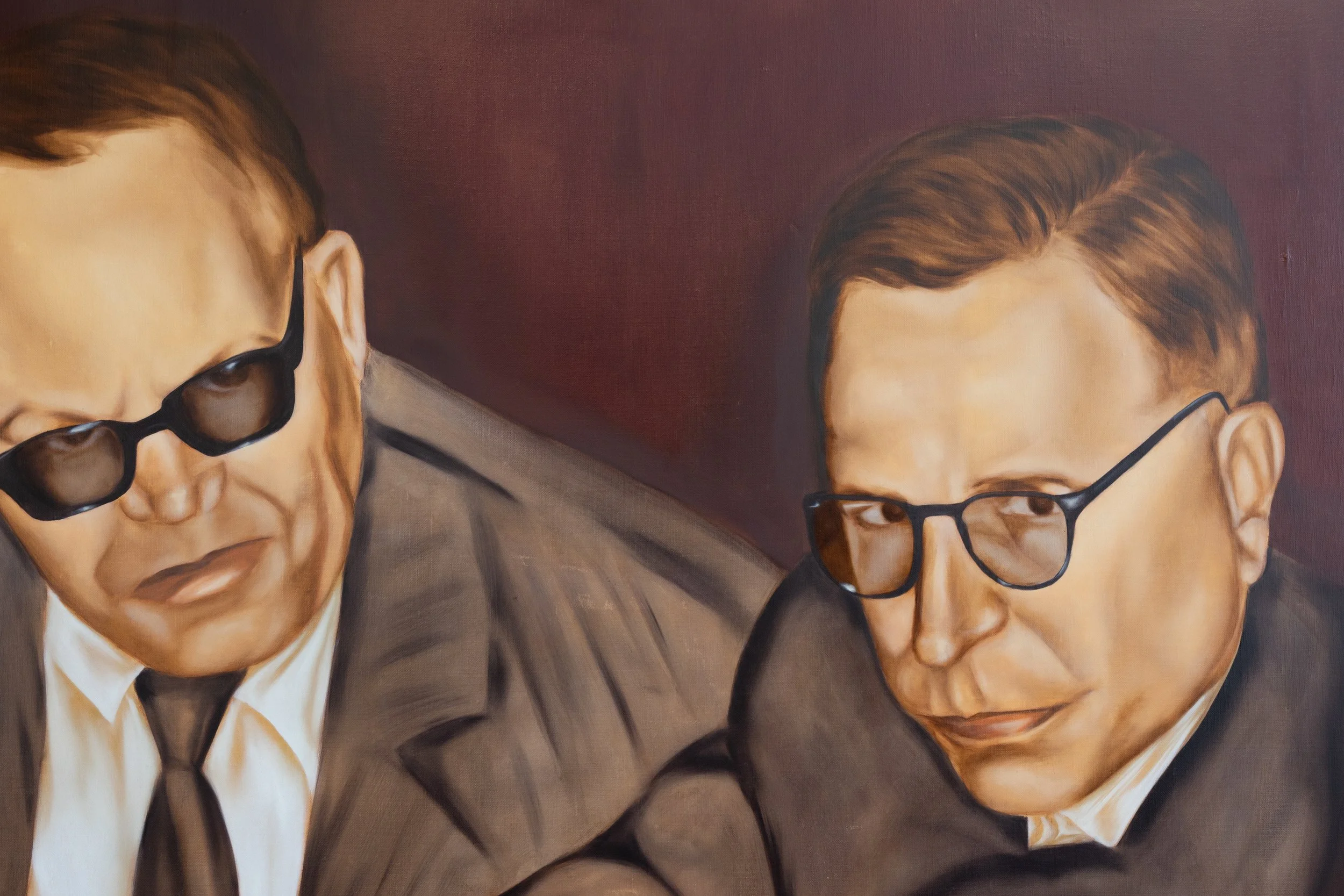
Detail from Album 7: Amman: 1950’s : 2 by Tiyana Mitchell
Eirini Meze: Do you know who all the people in the photographs are?
Tiyana Mitchell: That's actually one of the most interesting aspects of working with this archive. The specific photographs I'm painting from don't have captions, so it becomes its own journey — trying to figure out who these people are, what the context is. I ask my family when I can, and they help fill in timeframes and identities, but a lot remains unknown. I feel a similar sense of mystery looking at these images as the viewer does when looking at my paintings — and I think that's generative rather than limiting.
The Paintings: Timelessness, Anonymity, and the Fading Face
Eirini Meze: Your paintings are immediately recognisable — warm, brownish-gold tones, figures that seem to exist outside of any specific decade. Is that palette a deliberate choice?
Tiyana Mitchell: Very much so. I want them to feel like old photographs, but without being pinned to a specific era. The goal is timelessness — you shouldn't be able to tell whether something was taken in the forties, the fifties, or even closer to now. There are sometimes small clues, like the cut of a suit or a particular style of glasses, that give a vague sense of a time period, but I deliberately keep those details understated. The muted, sepia quality is central to that.
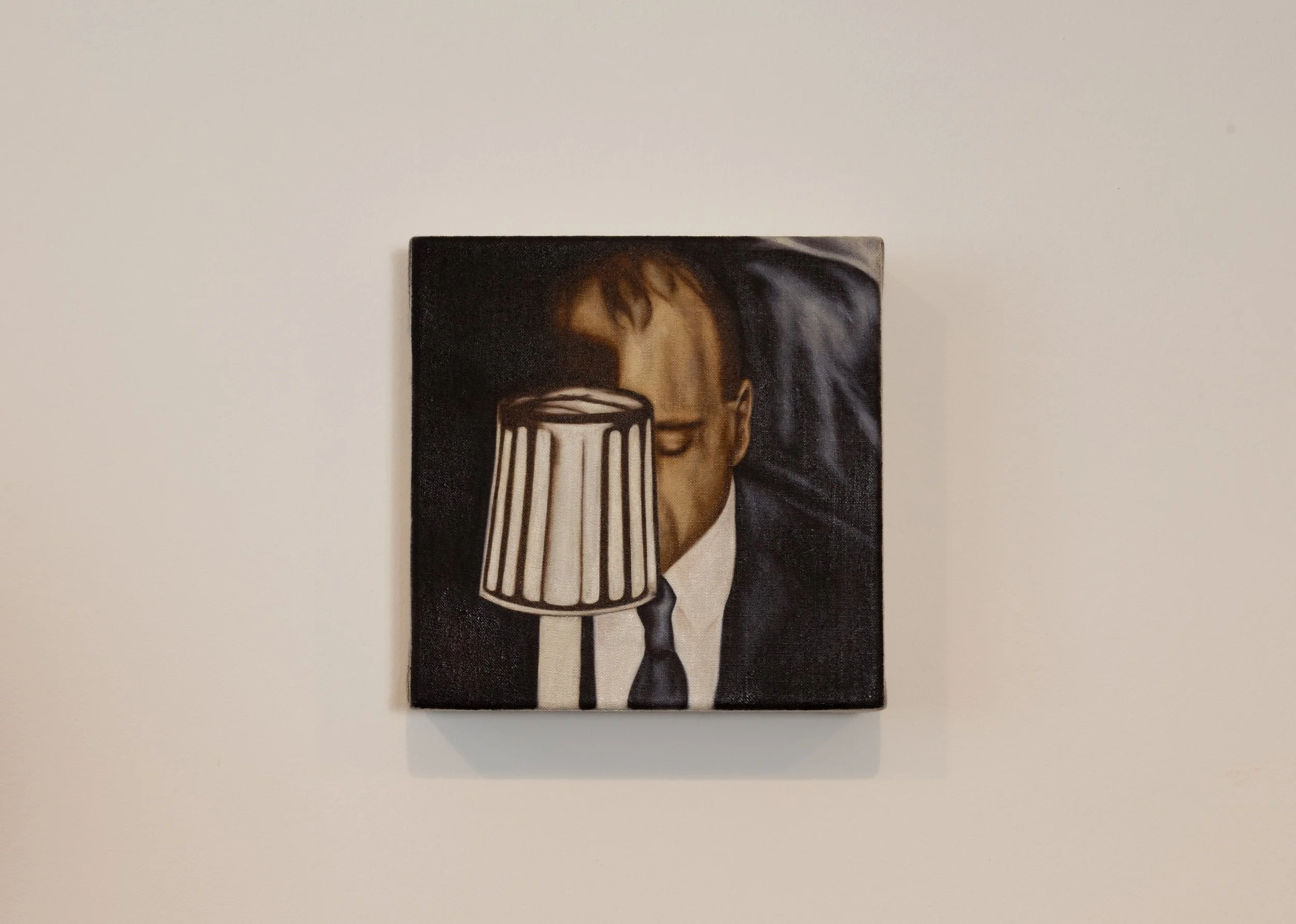
Tiyana Mitchell, Album 6: Marrakesh: 1976: 5, 2026
Eirini Meze: And the faces — they're consistently obscured or softened. That feels very intentional.
Tiyana Mitchell: It is. I paint the figures in a way that they lose a specific identity — they become a figure of a person rather than this particular person. I don't think any of the faces in my paintings are truly recognisable. That's intentional, partly because I often don't know who these people are myself, and partly because I want the figures to carry something more universal. They become vessels for memory and history rather than portraits of individuals.
Eirini Meze: The photographs you're working from — many of them seem to feature male-dominated gatherings. Is that a reflection of the context?
Tiyana Mitchell: I think the images I’ve been drawing tend to be ones that are from my grandfather’s early life in university and when he was with his friends driving in the desert, as well as more male dominated social and political scenes of my great grandfather. The draping of the suits is something that I have been fond of when translating the images into a painted format. Most of the later albums are images of my grandmother, and his daughters. I think because these are more personal private lives I tend not to paint them as much. For me in keeping the distinction between the personal and what I want to be shown this has been a line that has naturally developed within the work.
Process: Research, Restraint, and Staying Close to the Original.
Eirini Meze: How faithful do you stay to the original photographs when you paint them?
Tiyana Mitchell: I try to keep the integrity of the original as much as I can, I don't feel it is necessarily my place to distort my grandfather's intention with his images. Instead they become reflections of how I interpret his images and what catches my eye. I never paint the full scene of his original, even though it may look like they are always cropped from a larger image. There are many images which are highly detailed having three or four scenes within a single frame allowing me to go in and dissect these overlooked moments.
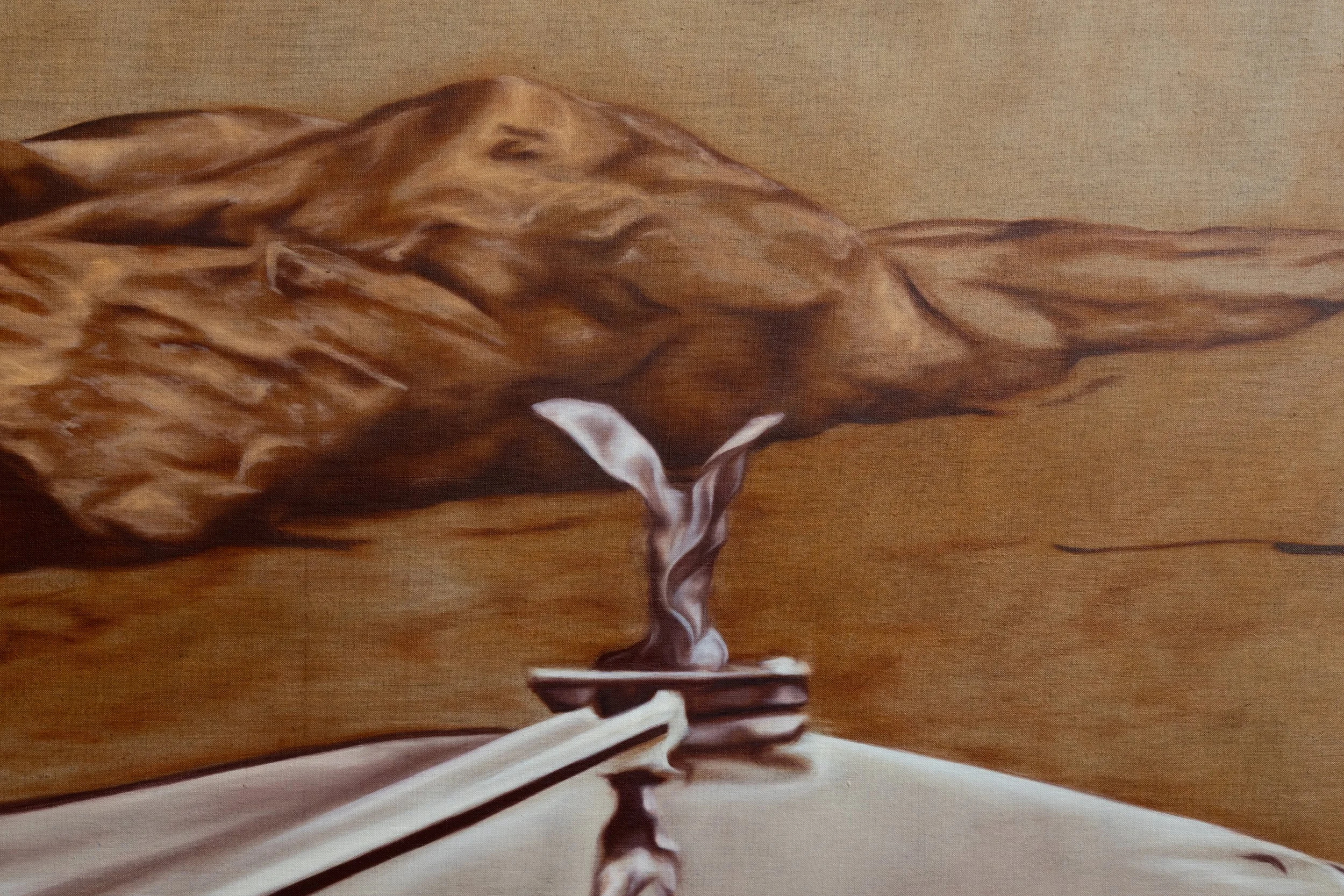
Detail from Album 1: Dead Sea: 1955: 2 by Tiyana Mitchell, London 2026
I might remove certain elements, simplify a background, or occasionally add a small detail like a carpet or a texture that feels right for the composition. The bigger intervention is in the looseness of the paint itself — how the faces are rendered, how the edges dissolve. The photograph becomes a starting point, not a blueprint.
Eirini Meze: And how do you date the works when the photographs themselves aren't labelled?
Tiyana Mitchell: The archive has some metadata that I can cross-reference, and then I do a lot of asking. I'll show a photograph to a family member and they'll give me a rough timeframe — "they were in this place in the fifties" or "this was around when such and such happened." It becomes a collaborative act of remembering, even if the memory is secondhand.
London, the RCA, and What Comes Next for Tiyana Mitchell
Eirini Meze: You have just graduated from the RCA — how has that shaped the work?
Tiyana Mitchell: My time at the RCA pushed me to really interrogate what I'm doing and why. It's an intense environment that truly makes you reflect on every aspect of the work. The conversations with peers and tutors have helped me think more rigorously about the relationship between photography and painting, and about how I position myself within the history of archival practice.
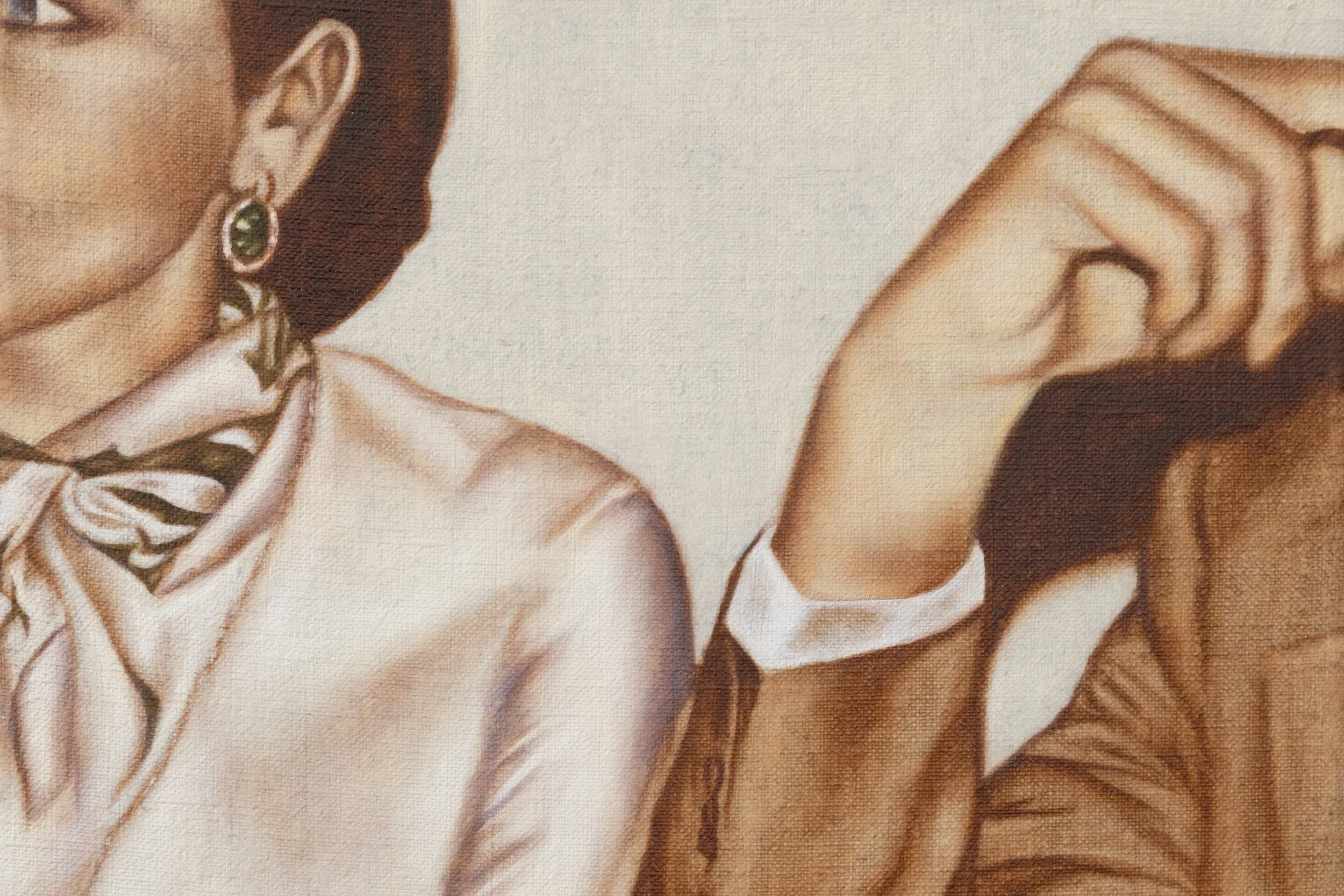
Detail from Album 2: Madrid: 1976: 1 by Tiyana Mitchell
Eirini Meze: Your work has already been acquired by some significant collections — the Ambassador of Jordan's official residence in Washington, Four Seasons Mumbai. Does that feel meaningful given the subject matter?
Tiyana Mitchell: Having support from such collectors at an early stage in my career, feels very motivating. Knowing that my pieces are in such special collections, especially having a piece at the Jordanian Ambassador’s residence was a big honour.
For enquiries about available works by Tiyana Mitchell.