

Mohini Kaur: Painting Through Body, Material, and Time
By Eirini Meze | MeSo Mag
Mohini Kaur is a London-based South Asian artist whose practice sits at the intersection of the somatic, the sacred, and the ancestral. Born in 1994 and raised between India and London, Mohini is an RCA graduate, holding an MA in Painting from the Royal College of Art (2024–2025). Working across painting, installation, sculpture, and photography, her practice is grounded in material processes and embodied gesture — approaching the body as something lived and worked through, rather than as a pictorial subject. This thinking sits within a framework she calls The Long Ancestral Body, and places her among a compelling generation of diasporic artists whose work moves fluidly between cultural heritage and contemporary art practice.
MeSo Mag sat down with Mohini to talk about where creativity begins, why she works at scale, how materials shift over time, and why she still needs her mother's help to drape a sari.
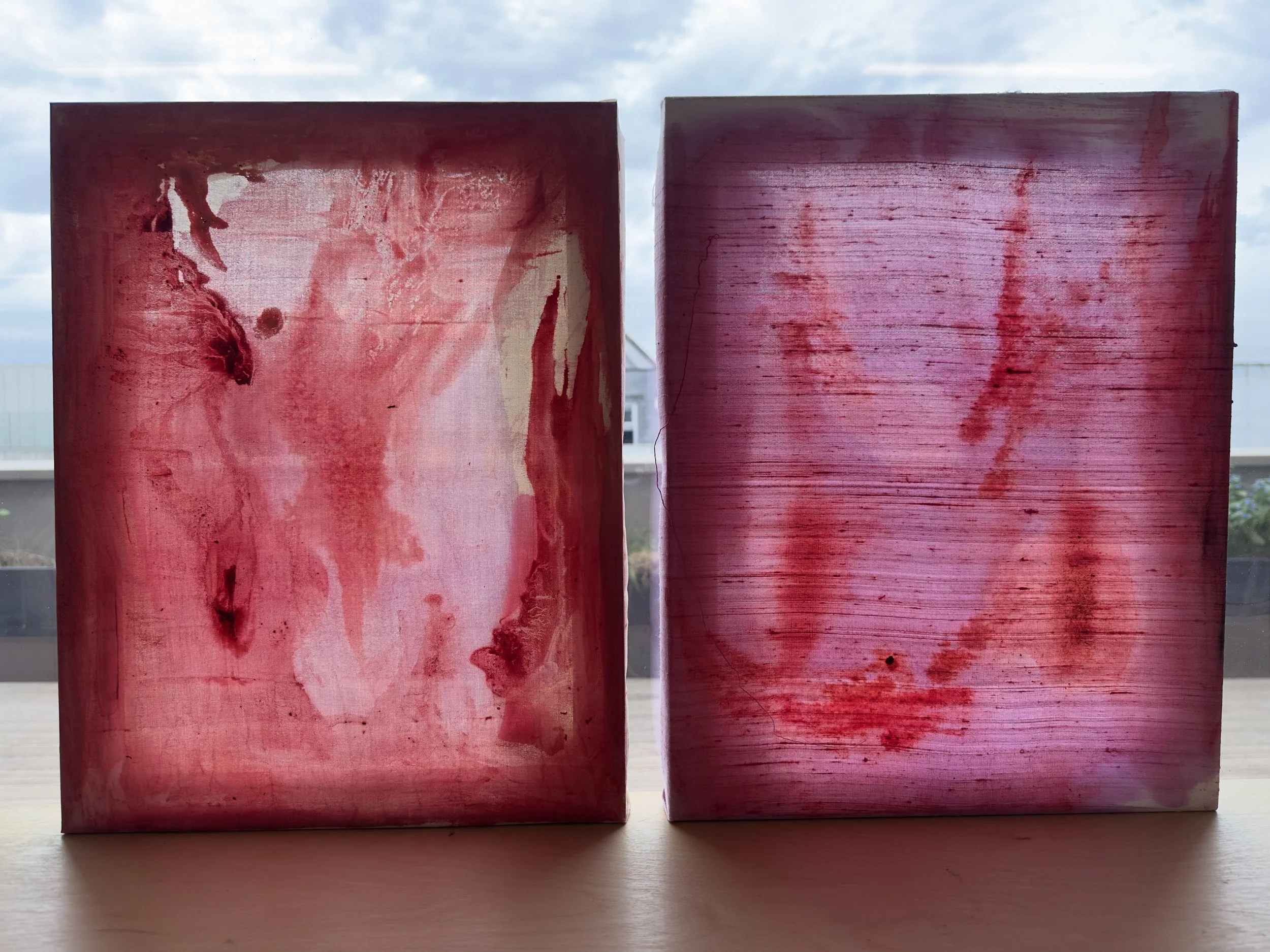
Mohini Kaur Studio, Kali series
A Creative Lineage: Where It All Began
You came to painting without a formal art degree. How did creativity first enter your life?
I grew up in a home where expression was part of everyday life. My mother is a singer and dancer, so there was always rhythm, movement, and feeling shaping the atmosphere around me. No one pursued an artistic path professionally, but it was embedded in how we lived.
I was drawn to the performing arts early on, theatre and singing occupied my teenage years. During my degree in Philosophy at King's College London, I was making art too, but more quietly. I returned to painting intentionally in the years just before Covid, and at a certain point, something shifted. It was no longer something at the edge of my life, but something I was fully absorbed by. Since then, painting has been a constant, something I return to every day.
"It was no longer something at the edge of my life, but something I was fully absorbed by."
Getting Into the RCA: A Portfolio Built in Private
How did you end up applying to the Royal College of Art with no prior art degree?
Studying philosophy was never separate from the painting, it was the same conversation happening in a different context. I was sitting in seminars with questions about consciousness, perception, and embodied experience, and through these, something was taking root. The very simple idea that there are different ways of knowing shaped my curiosity about what can be learned through sensation and movement, and my practice developed through that.
Applying to the MA at the Royal College of Art came out of this. I was already building a practice through these questions, and the RCA felt like a place where that thinking could be pushed further through material and process. It just felt like the natural next move.
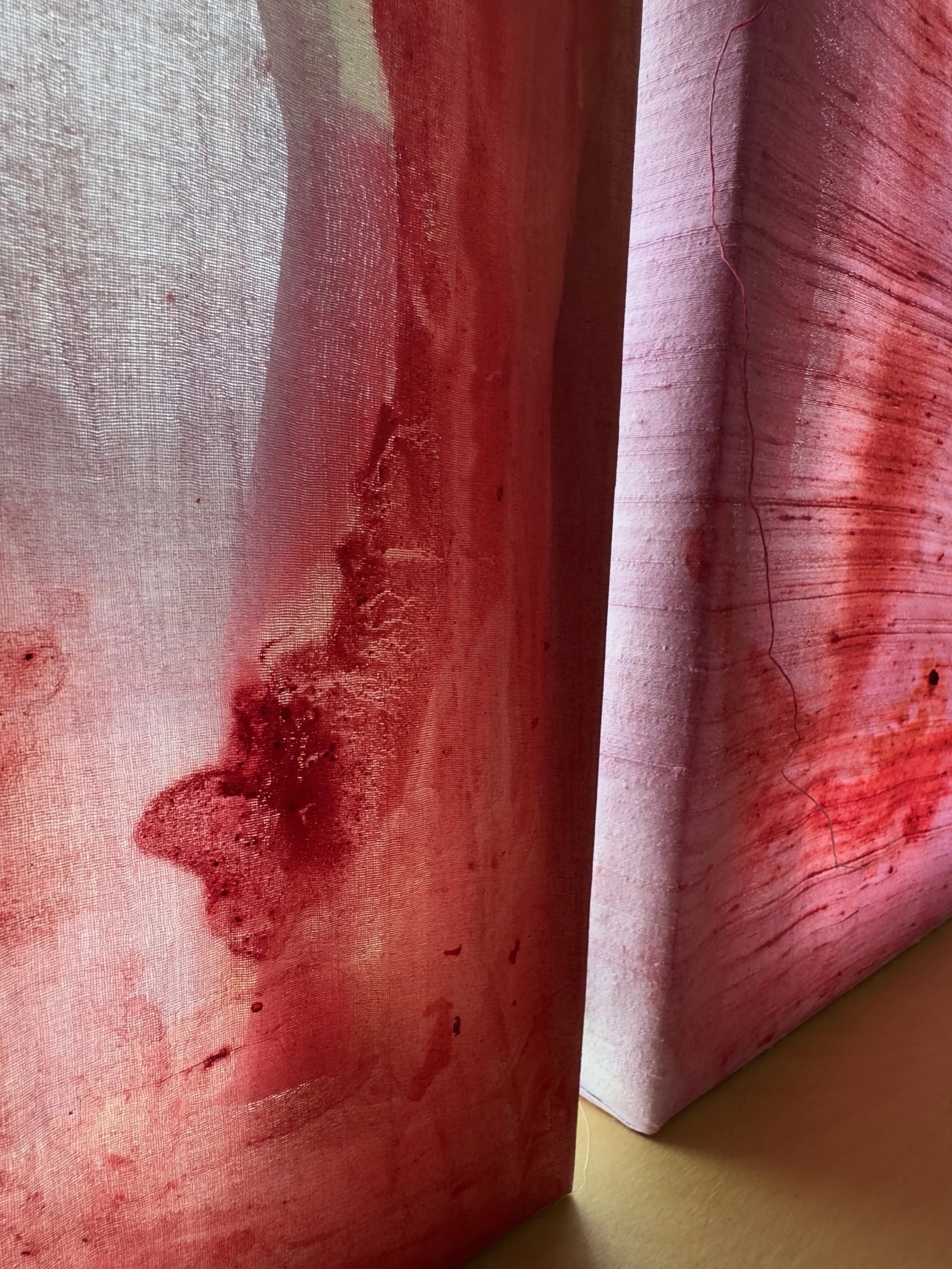
Mohini Kaur Studio, Kali series
Between London and India: A Practice Rooted in Both
You have a studio in London and you are showing in Mumbai, India. How do you think about your relationship to both places?
Both places are genuinely home, I've spent roughly half my life in each. They are active in the practice, though they work differently. In London, there's the continuity of the studio, the daily rhythm of making, and the dialogue with the wider ecosystem of contemporary art. In India, the work shifts in register. I'm moving through sacred landscapes and materials that carry emotional, historical and ritual charge, understanding how they are held and lived within different contexts. These are all essential to the work's thinking, its spirituality, its material logic.
The practice doesn't move between these places so much as it accumulates through them. That movement is integral to the work. And to me.
"The practice doesn't move between these places so much as it accumulates through them."
The Materials: Sacred, Sensory, and Time-Based
Your work uses a remarkable range of materials — kumkum, sacred ash, turmeric, silk, sand, salt, and translucent canvas. Can you walk us through what each brings to the work, and how you choose and source them?
I'm drawn to materials that arrive already active — environmentally, culturally, temporally — continuing to act within the work long after it's made. I love to seek them out, spend time with them and recognise how I can work with their aliveness.
Ash grounds a surface. As a residue of burning, often applied to the skin in ritual contexts across India and beyond, it carries associations of dissolution, mortality, and return. Silk absorbs pigment almost in a bodily way, and also holds a history of moving between regions. Salt introduces resistance and crystallisation. It preserves and dries, and carries legacies of taxation and extraction. Sand adds weight and abrasion. Kumkum gathers in ways that resist control; when used as markings on the forehead and body, it is associated with ritual practices and divine presence. Because it's derived from turmeric, it remains light-sensitive, fading and shifting over time.
These are not inert materials; they remain in process, responsive to time and environment. This runs through the making - in the translucent KALI works especially, it has been important to observe what holds and what is allowed to move. The silk surface makes room for a kind of porousness that lets light work as a material. As light enters, control is relinquished.
There is something in that permeability that speaks to maya — the veils of illusion central to Indian philosophical thought. Silk holds that tension: it lets light in, but it also reminds you of what you cannot fully see through.
"These are not inert materials — they remain in process, responsive to time and environment."
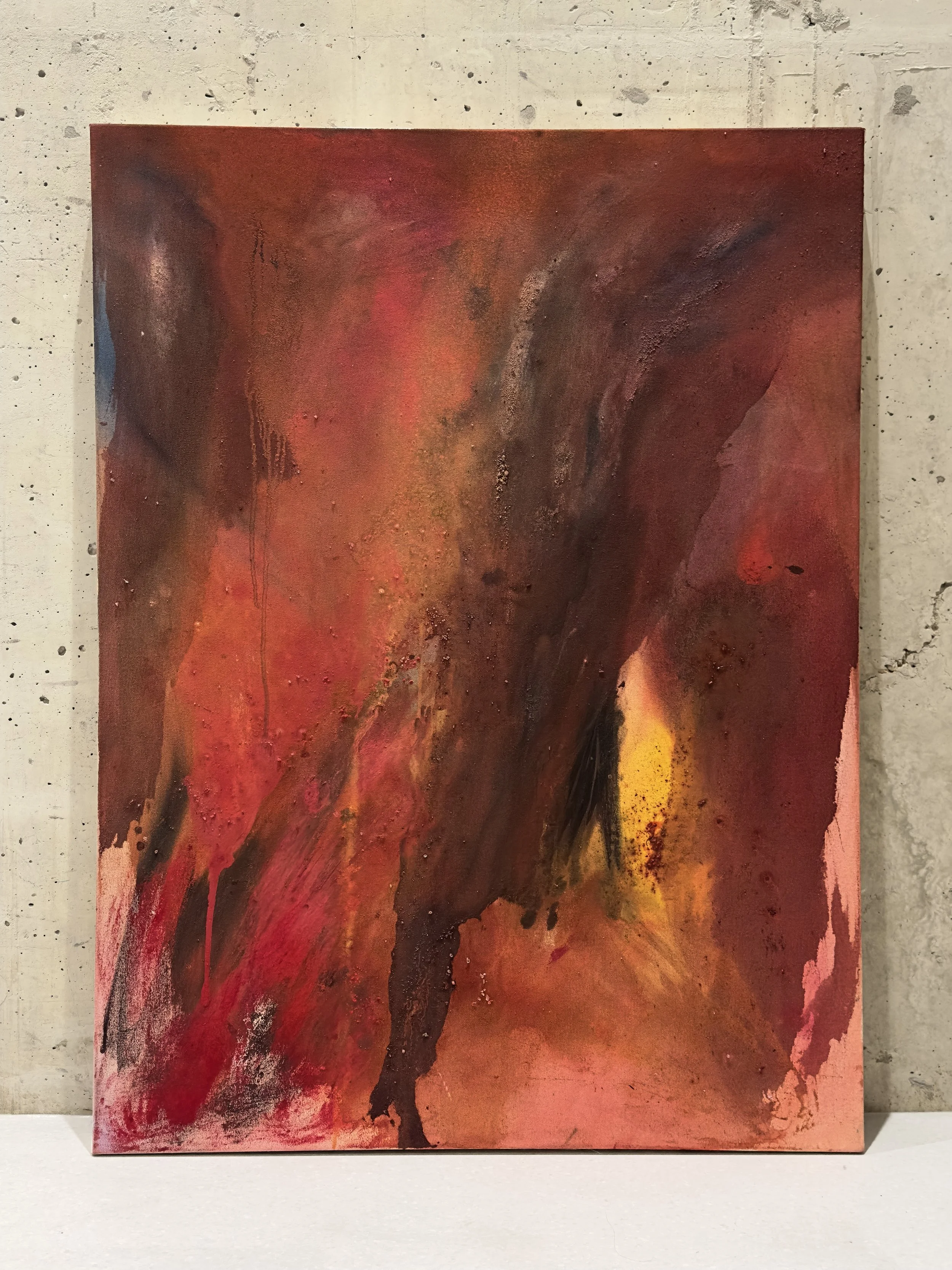
Mohini Kaur Studio, Kali series
The Long Ancestral Body: A Framework for the Work
Your practice is grounded in what you call 'The Long Ancestral Body.' Can you explain this framework?
The Long Ancestral Body first came to me through meditation, where I experienced ancestry as something continuous rather than fixed in the past, extending both backwards and forwards at once. It shifted how I understood inheritance: not as something received and carried, but as something we are already within, and actively shaping.
Through this framework, I understand the self as part of a larger ecological and ancestral field, where the body exists in relation — to past generations, to land, to non-human life, and to forces that exceed individual lifespans. I often think about the Hindi word kal, which holds both yesterday and tomorrow. That collapse of tense reflects something central to the work: time as cyclical rather than linear, as something we inhabit rather than move through. It is a way of understanding identity, memory, and cultural heritage as a living, continuous process.
In the studio, this shapes how I make. When working on my long-format pieces, I work in sections and don't see the whole piece until it's complete. What began as a spatial constraint has become a method. By staying close to the surface, the work unfolds without being settled too early, holding multiple temporalities at once. The framework isn't only an idea. It lives in the making.
Working at Scale: The Body as Method
So much of your work is large scale. Why?
There is so much history of the female body being compressed, contained, restricted - kept within certain limits of space and reach. Working at scale begins as a refusal of that. A way of giving my body the room it actually requires. To extend, to gesture, to move through its full range. To take up room without apology.
Something happens when the work becomes that large. I can't hold it all at once. I have to move with it, stay inside it, and I have to keep negotiating with the surface, finding my way across it. That proximity has become essential to the method. I am always in conversation with the work, discovering what wants to arrive.
This kind of full-body engagement refuses easy resolution. The work stays open in the same way the body does when it is fully present in something. I need that aliveness. So does the work.
The Sari, The Sculpture, and The Offering
You draped one of your works like a sari. Can you tell us about that decision?
My work titled “I draped her like my mother’s saree, but I cannot drape my own saree” came from something I kept noticing in the studio. I was working in sections, folding large lengths of canvas, and I began to recognise a parallel with the sari. I kept returning to the fact that I cannot drape my own sari, I still need my mother's help.
There was something both arresting and uncomfortable in that recognition: here I am, shaping fabric on canvas with some fluency, and yet this garment so central to the Indian body, I cannot drape it alone.
What this reveals isn't simply a missing skill, it's more like a gap in continuity. A form of knowledge that has intimately moved between South Asian women, through proximity and repetition, through watching and being shown. That kind of learning requires time and closeness. My mother carries it. I am still finding my way to it.
I don't think I'm alone in this feeling. Something is shifting in how this kind of knowledge is passed on in our generation — how embodied cultural heritage travels, or doesn't, across diaspora. At some point I thought: if I were to have a daughter, I would want to be able to teach her. The sari matters, not just as a garment, but as a living thing.

“I draped her like my mother’s saree, although I cannot drape my own saree”, Mohini Kaur
In your RCA graduation piece, you created a sculpture and an offering as part of it. Can you describe it?
The offering began as an act of gratitude for everything that made that moment possible. The sacrifices, the love that came before me. I wanted to acknowledge that in a tangible way.
I burned hand rolled incense and installed a series of sculptures titled “I use my hands to press your feet; a bed of blessings”. Each one began with pressing my own fingers into clay, forming feet with many toes, one for every generation I cannot name. In some Indian cultures, we touch the feet of our elders to receive their blessing, to honour what they carry. The red kumkum in the grooves of each sculpture holds that same devotion — made material, pressed gently into the toes to complete the work. This is my favourite part of the offering, as it requires me to breathe gently to keep the kumkum in place. It becomes a beautiful meditative moment.
And so these works point towards a lineage of touch, of making, of bodies that precede mine.
They began as an entirely private practice, held close to me. At a certain point I chose to bring them into dialogue with the paintings, and that shift matters. It changes how intimacy operates in the work, how something held close can also exist in relation to others.
There is something tender and exposing about that, allowing what was made in private to become something witnessed. These sculptures were a conversation I was having with my ancestors, with myself. Sharing them doesn't change what they are, but it does change what they ask of me. It asks me to trust that the intimacy survives being seen. That it doesn't collapse under the weight of an audience, but opens, the way a hand opens when it finally lets something go.